
AP7 climate action plan
The AP7 Climate Action Plan is a summary of how AP7 plan to contribute to attaining net zero emissions globally by 2050.
 Read AP7’s Climate Action Plan
AP7’s mission, to deliver strong returns for our savers, relies on the implementation of the Paris Agreement and on long-term sustainable global development. Achieving global net-zero emissions by 2050 places high demands. With our Climate Action Plan, we aim to clearly demonstrate our commitment to being a positive force in reaching this climate target, and to set out how we will proceed.
Each year, we assess our portfolio using the Net Zero Investment Framework. This results in a categorisation based on the degree of maturity of the companies’ climate work. We have now achieved our 2025 goal that at least 50 percent of the companies responsible for 70 percent of our portfolio’s carbon emissions (scope 1 and 2) should have credible transition plans in place by 2025 at the latest.
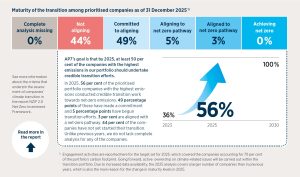
We also set a goal for 2025 that all of these companies should be subject to intensified active ownership towards achieving net-zero emissions in line with the Paris Agreement. At year-end, 88 percent were covered by such engagement. The remaining companies lack the transition potential needed to justify continued intensified active ownership. Going forward, the intensified active ownership on climate change issues will take place within AP7’s transition portfolio.
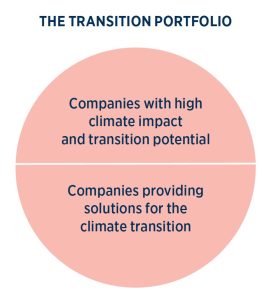
The overarching purpose of the transition portfolio is to contribute to real-economy effects through globally reduced emissions. For this reason, we seek both solution-oriented companies and companies that currently have a significant need to transition, where we, as active owners, can help accelerate the process. Ideally, these companies can eventually act as pioneers and catalysts within their respective industries. By 2030, 100 percent of the companies in the transition portfolio should be conducting credible transition work.
The fixed-income market plays an important role in the green transition. Green bonds already make up a large share of AP7’s fixed-income portfolio and our goals is that the amount of capital invested will increase over time. Since 2025, AP7 also invests in corporate bonds, providing a broader range of issuers and additional opportunities to deliver real-world impact. By 2030, all companies in the corporate bond portfolio must have adopted comprehensive targets and strategies for emissions reductions and demonstrate that credible transition work has begun.
In 2025, we set climate targets for alternative investments for the first time. The real estate sector accounts for a significant share of global greenhouse gas emissions and is therefore crucial to achieving the Paris Agreement’s 1.5°C target. Our objective is that, for each new real estate acquisition, credible climate targets and an associated roadmap are established within six months. Real estate companies are expected to actively contribute to reducing the portfolio’s emissions per unit of floor area over time. For Private Equity, managers’ climate efforts are required to demonstrate clear annual improvements in our evaluation system and, to an increasing extent, include credible climate targets.
In order to assess how our investments are affected by climate change, we encourage transparent reporting. AP7 was a driving force in the development of the Global Standard on Responsible Corporate Climate Lobbying – a standard for analysis and reporting of companies’ climate lobbying. We have applied the global standard to our own operations to increasing our own transparency and identifying areas for improvement and more in-depth work: AP7 Public policy dialogue and climate lobbying
Read AP7’s Climate Action Plan 2026
Read our previous Climate Action Plans:
AP7 Climate Action Plan 2025
AP7 Climate Action Plan 2024
AP7 Climate Action Plan 2023
AP7 Climate Action Plan 2022