
ESG
AP7’s promise to our savers is to create good returns in a responsible way through our asset management. In our work, we consider corporate governance, and environmental and social responsibility.
As a long-term and global investor in more than 2,000 companies worldwide, we are best positioned to make a difference through active ownership and by investing in companies that provide solutions to sustainability challenges, such as climate change, biodiversity and working conditions.
Climate change is one of the most urgent sustainability issues of our time. We therefore make dedicated efforts with the overall goal of reducing global greenhouse gas emissions. Read more in our Climate action plan.
AP7 applies a range of methods and works across multiple levels, with the aim of achieving real economic impact through responsible asset management.
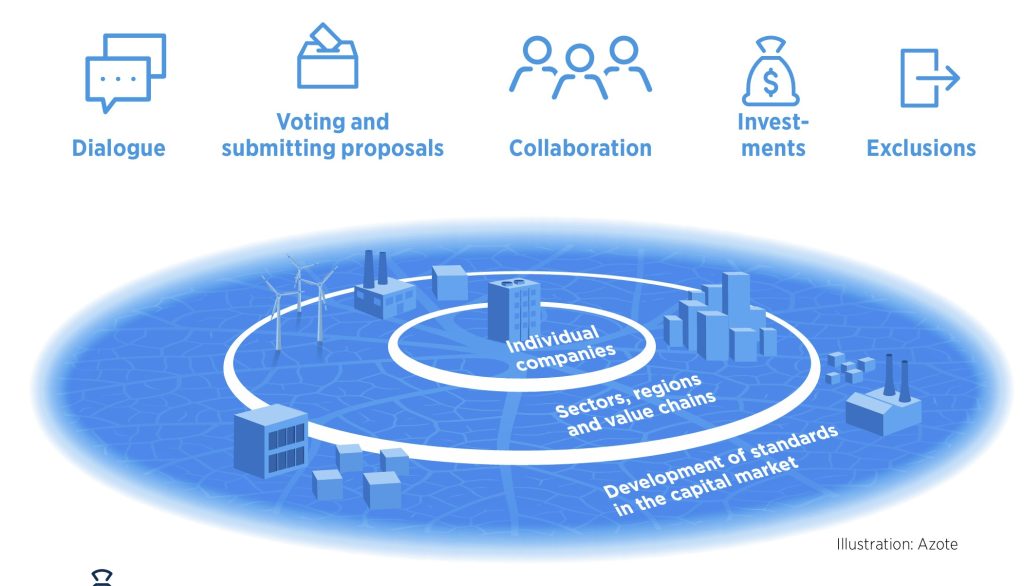
Dialogue
Dialogue is a central tool for influence on several levels. We can have direct dialogue with individual companies, with sectors, regions and throughout entire value chains. We can also use dialogue to influence the development of capital market norms. Dialogue with companies is fundamental to all active ownership activities, and is often moste effected when combined with other methods of active ownership.
Voting and proposals
Voting at the Annual General Meeting is AP7’s primary tool for influencing the majority of portfolio companies and advancing principle-based positions on sustainability issues, as outlined in AP7’s voting policy. Submitting our own proposals is also an effective way to caputre the attention of company boards.
Collaboration
AP7 can achieve greater impact by collaborating with other actors who share similar ambitions, for example by submitting joint proposals at general meetings. Together with other investors, AP7 also develops norms, guidelines, and positions for responsible ownership.
Investments
As an investor, AP7 can allocate capital to companies that contribute solutions to sustainability challenges, such as climate innovation. As per year-end 2025, AP7 had SEK 83 billion in green, social and sustainable bonds, where proceeds are earmarked for environmental and social projects around the world. AP7 also sets ambitious climate targets for real estate and private equity investments, and has developed a transition portfolio to contribute to global net zero emissions. This is described in more detail in our Climate action plan.
Exclusions
AP7 excludes companies that:
- are assessed to act in breach of, or have excessive and unmanaged risks related to, the principles set out in the international guidelines and conventions that Sweden has endorsed,
- are assessed to be involved in the development and/or production of cluster munitions, anti-personnel mines, biological and chemical weapons, as well as nuclear weapons,
- produce narcotic-classified substances for non-medical use, and/or products containing narcotic-classified substances (for example cannabis).
AP7 also excludes companies that conduct operations with a significant climate impact and that are assessed to have insufficient transition potential in their business.
Companies with significant climate impact are defined as companies that meet any of the following criteria:
- produce at least 50 million barrels of oil per year
- derive at least 50 percent of revenues from the production and/or exploration of oil
- derive at least 5 percent of revenues from oil sands
- derive at least 5 percent of revenues from Arctic oil extraction
Companies with significant climate impact are also defined as companies that meet any of the following criteria:
- produce at least 5 million tonnes of thermal coal per year
- derive at least 25 percent of revenues from the extraction and production of thermal coal
- have at least 5 GWh of installed capacity for electricity generation from thermal coal
However, companies assessed to have significant climate impact according to the above may be included in AP7’s actively managed transition portfolio if they meet our financial and sustainability criteria for transition potential.
Read more about our approach to exclusions: AP7 introduces framework for risk-based exclusion
AP7 Thematic work
AP7 complements its active ownership with thematic focus areas structured in three-year periods. This approach enables deeper engagement in particularly important sustainability issues. Read more about AP7:s Thematic work.
Further reading
Read more in our Annual and Sustainability Report